
Guide
Doorway chest stretch: supported setup and a gentle return
Use a sturdy open doorway, with your hands and forearms supported on its sides around shoulder level. Move forward gently until you notice a mild chest stretch, then ease back to release it. Keep the movement small; pressure at the front of a shoulder is not a reason to push farther.
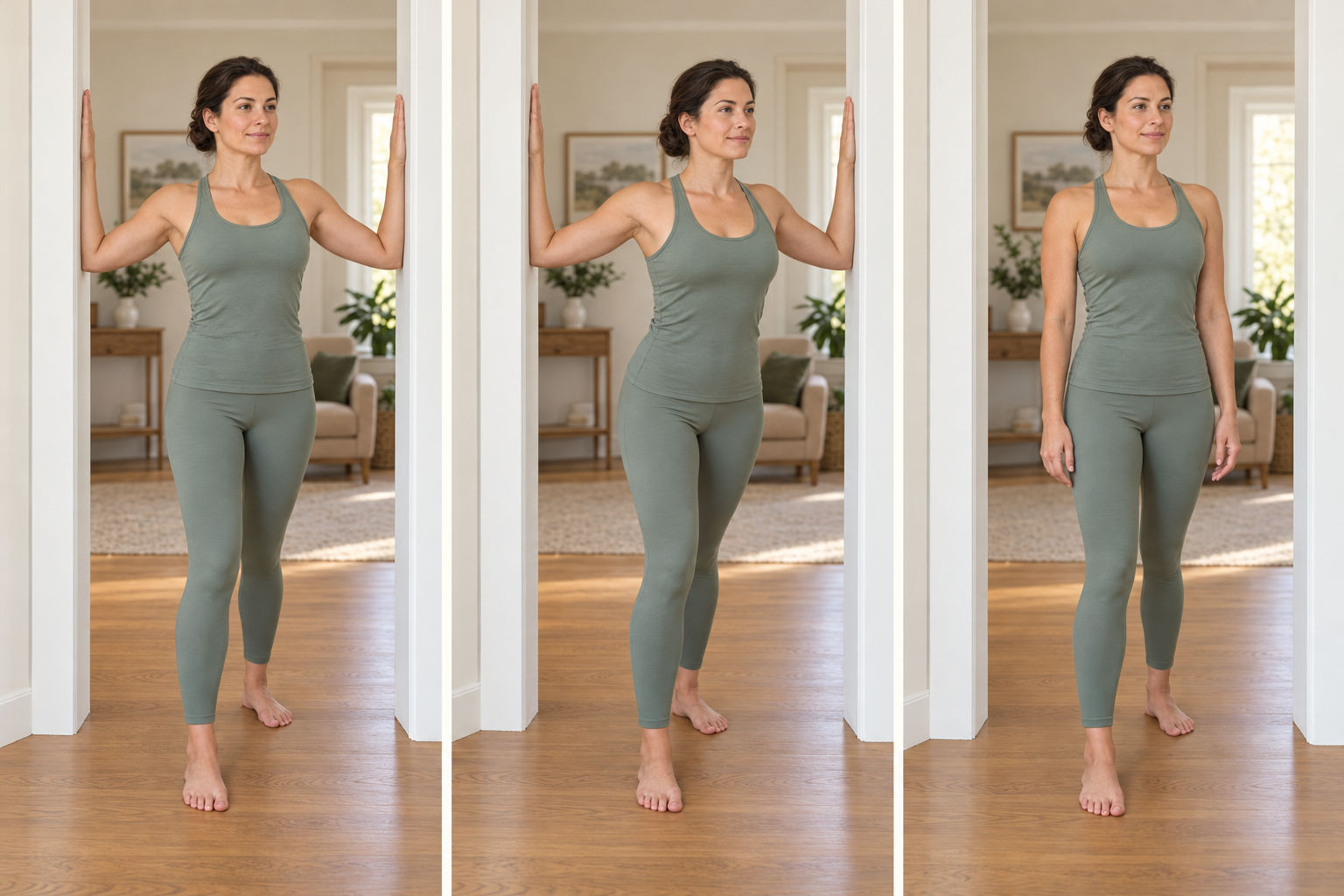
Prepare a stable support
Choose a doorway with firm sides and enough room to stand comfortably. Keep the door secured away from your hands and do not use a moving door panel as the support. Remove anything that could make you trip.
This page describes the two-arm variation. The illustrations show the supported setup, a small forward shift and the release. It is not a depth or flexibility target.
Set, ease forward and release
- Stand in the open doorway with stable feet. Place your hands and forearms on its sides near shoulder level.
- Ease forward a little, keeping your neck and shoulders relaxed. Stop at a mild stretch across the chest without forcing the shoulders.
- Ease back to remove the stretch. Lower your arms and relax before deciding whether to repeat.
Learning the position is different from following a prescription
Start by understanding where the support is and how to leave the position. A demonstration lasting a few seconds is not automatically the duration you should hold a stretch. This guide does not assign a universal daily dose.
The source contains a clinical exercise schedule for people following a specific care plan. That schedule is not copied here as general advice. If you are recovering from surgery or injury, use your own clinician’s instructions instead of this general guide.
Checks before you continue
| Check | Useful response |
|---|---|
| The doorway or door moves | Stop; choose a firm, safe support. |
| You feel pressure or pain at the front of a shoulder | Release the stretch rather than stepping farther. |
| You hold your breath or tense your neck | Ease back and reset with a smaller movement. |
| You need a different arm height or a one-arm version | Treat it as a separate variation; seek suitable instructions rather than improvising from this illustration. |
Connect the movement to a useful routine
A stretch is one movement choice, not a way to lock your shoulders into one position for the rest of the day. Use the desk guide to plan changes of activity, the exercise page for a sequence, and the program page to understand Renava’s daily structure.
Questions about this guide
Should I push through shoulder discomfort?
No. Release the position and stop if it hurts or brings unusual symptoms. A general web guide cannot decide whether this variation suits your shoulder.
Is a five-second clip the prescribed stretch time?
No. A clip can demonstrate a position without prescribing a training duration. Follow your individual plan where applicable.
Can I use the edge of a loose door?
Use firm doorway sides. A door that can move or close is not a stable support for this version.
Sources and editorial notes
External sources provide background and have not reviewed or endorsed Renava. Instructions and routine details describe the app team’s own material.
- Memorial Sloan Kettering · Pectoral stretch using doorway — The linked resource is written for a specific clinical context. Only its doorway setup informs this general movement explanation; its rehabilitation schedule is not adopted.
Follow your next session in Renava
See guided sessions, the program and your practice record. Check the current free and paid access in the app or your store before subscribing.