
Guide
Wall slides facing the wall: a controlled shoulder movement
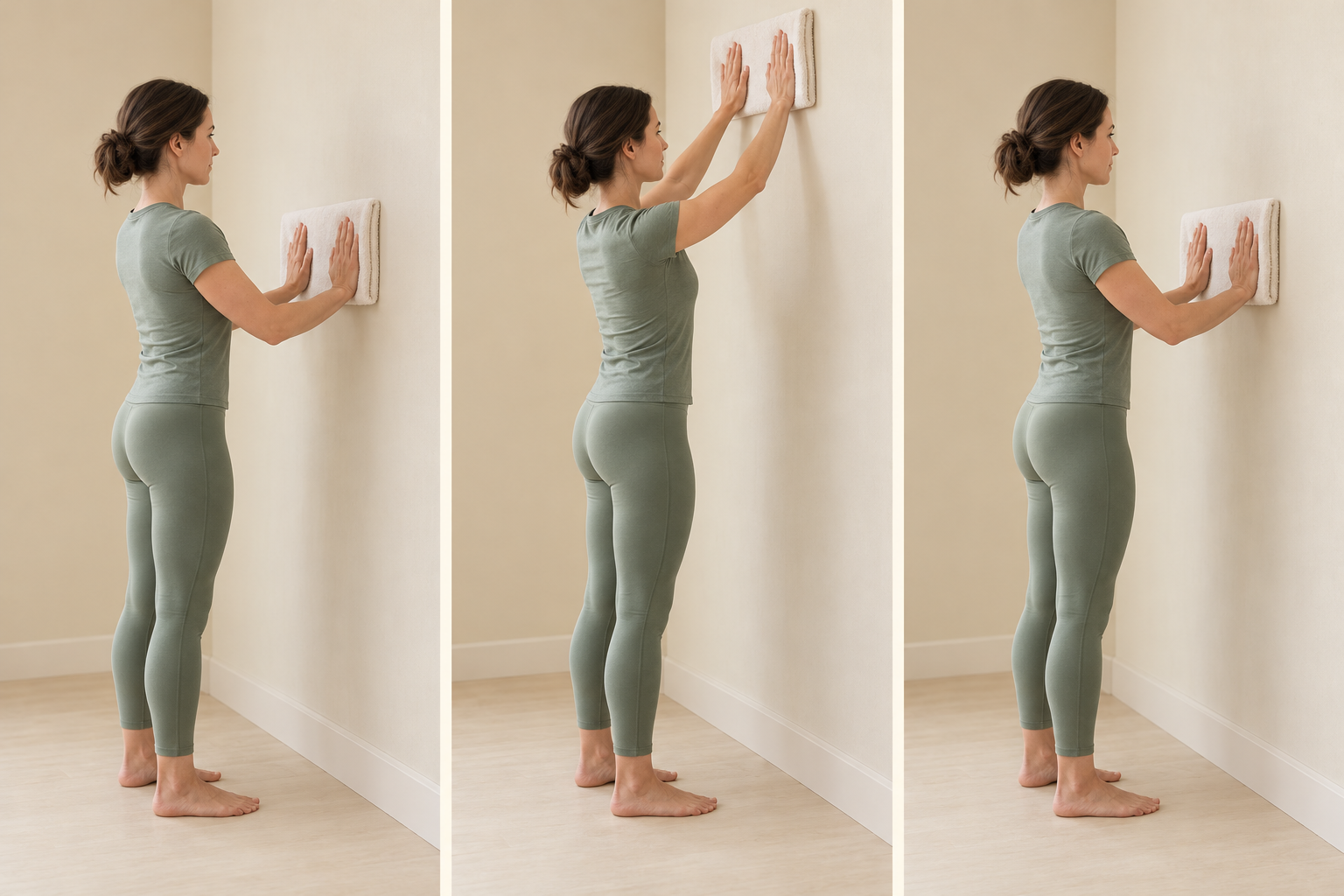
Face a smooth wall with your hands resting on a towel. Slide the towel upward within a comfortable reach, then bring it back down slowly. This is a facing-the-wall movement; it is different from a wall angel with your back against the wall.
Choose the version before you begin
This guide covers an unweighted wall slide with both hands supported by a towel. It does not use a resistance band or a roller. Choose a smooth, clean wall and a towel that moves without catching. Clear the floor so you can stand securely.
The illustrations show a modest example reach. They are simplified movement illustrations, not a target angle or a test of shoulder health. The written instructions apply to both hands.
Setup, reach and return
- Stand facing the wall at a distance that lets you place both hands comfortably on the towel, with your elbows bent. Keep your feet stable.
- Let the towel travel up the wall slowly. Keep the motion smooth and stop at a comfortable height; do not force extra reach by leaning your whole body forward.
- Bring the towel back to the starting height with control. Let your arms relax before deciding whether to repeat.
Make the first attempt small
Watch the three positions before trying the movement. Explore one controlled upward-and-downward pass rather than racing a countdown. A small reach that returns smoothly is more useful for learning the sequence than an overhead position reached with strain.
The linked handout includes a repetition example for its own context. Renava does not turn that into a universal prescription. If you have an individual exercise plan, follow its range, repetitions and restrictions.
If the movement is awkward
| What happens | A practical adjustment |
|---|---|
| The towel catches | Stop and check the wall and towel before starting again. |
| You lean or arch to reach higher | Return to a shorter reach and keep the movement controlled. |
| You rush the downward phase | Practise a smaller upward reach with a deliberate return. |
| The movement hurts or brings unusual symptoms | Stop and seek individual advice rather than pushing through. |
Where it fits in a routine
Learning this movement is a different task from completing a whole posture session. Use the exercise-sequence page when you want a routine you can follow, or the program page when you want to understand the daily structure. No single drill establishes whether your posture is correct.
Questions about this guide
Are wall slides and wall angels the same?
Names vary between exercise libraries. Here, wall slides face the wall with hands on a towel; wall angels use your back against the wall. Check the setup rather than choosing by name alone.
Do I need to reach all the way overhead?
No. Use a comfortable controlled range. The illustration shows a direction of travel, not a required finishing height.
Can I add a band or roller?
Those create different variations. They are not needed for the towel-assisted version explained on this page.
Sources and editorial notes
External sources provide background and have not reviewed or endorsed Renava. Instructions and routine details describe the app team’s own material.
Follow your next session in Renava
See guided sessions, the program and your practice record. Check the current free and paid access in the app or your store before subscribing.